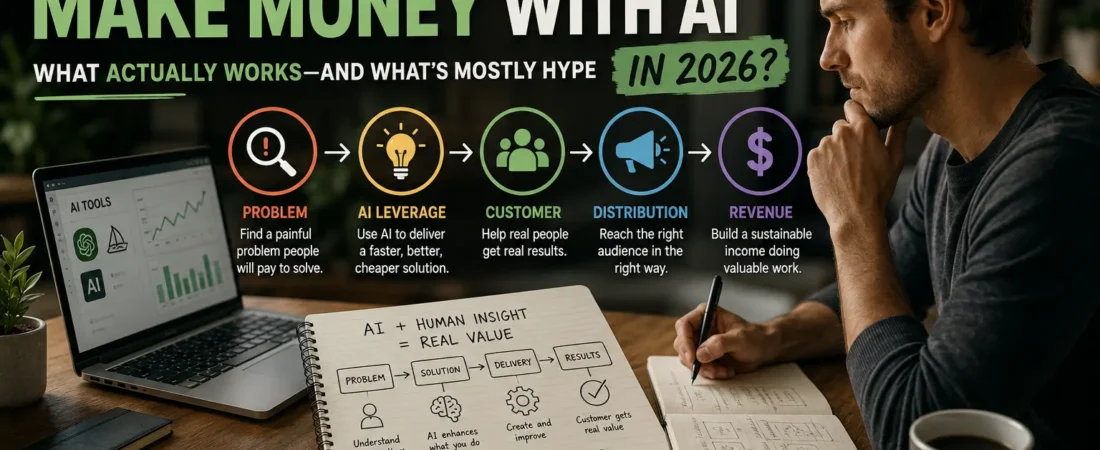
What Actually Works—and What’s Mostly Hype
You can make money with AI in 2026, but AI itself is rarely the business. The real opportunity comes from using AI to solve problems people already value.
That’s the part that gets lost when you scroll through social media.
Open YouTube.
TikTok.
X.
Instagram.
Sooner or later, you’ll see some version of the same promise:
“I made $10,000 with AI in 30 days.”
Then comes the formula.
Generate an ebook.
Create AI art.
Start a faceless YouTube channel.
Sell prompts.
Build an AI agency.
Upload AI music.
Create hundreds of blog posts.
Automate everything.
Collect passive income.
It sounds incredibly easy.
And that’s exactly why we should be skeptical.
Because if anyone can generate the same product in thirty seconds, an uncomfortable question appears:
Why would someone pay you for it?
AI Doesn’t Create Demand
Imagine discovering an AI tool that can produce children’s coloring books.
You generate one.
It looks good.
Then you generate twenty.
Then one hundred.
You’ve solved the production problem.
But you haven’t answered the business question.
Who wants them?
Why would they choose yours?
How will they find them?
What makes one worth paying for when thousands of other people have access to the same generator?
AI can dramatically reduce the cost of creating supply.
It doesn’t automatically create demand.
That distinction explains why many “AI side hustles” sound much better in tutorials than they perform in reality.
The Wrong Question Is “What Can AI Make?”
AI can make almost anything digital now.
Articles.
Images.
Logos.
Presentations.
Music.
Video.
Code.
Research summaries.
Product descriptions.
Voiceovers.
Courses.
That list will keep growing.
So asking:
What can I make with AI?
is becoming less useful every year.
A much better question is:
What problem will someone pay me to solve—and can AI help me solve it faster or better?
That reverses the entire process.
Don’t start with AI.
Start with value.
The AI Money Equation
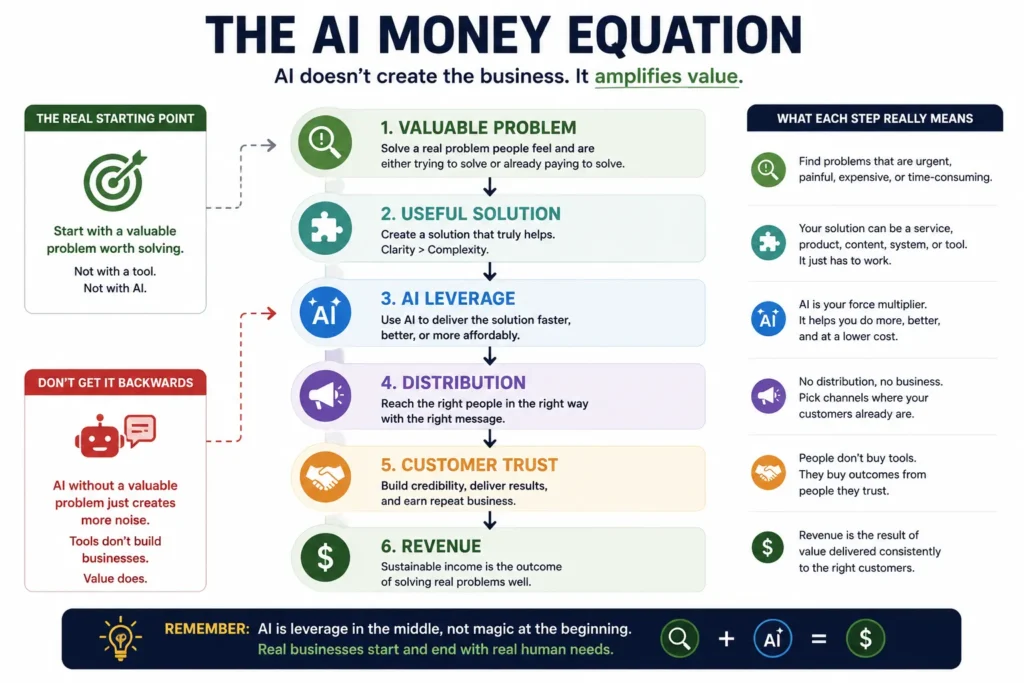
I think about AI businesses using a simple framework:
Valuable Problem
→ Useful Solution
→ AI Leverage
→ Distribution
→ Customer Trust
→ Revenue
Notice where AI appears.
In the middle.
Not at the beginning.
And definitely not at the end.
AI helps you produce the solution more efficiently.
It doesn’t guarantee that the problem is valuable.
It doesn’t find customers automatically.
And it doesn’t make people trust you.
Why the Easiest AI Businesses Become Crowded First
Suppose someone discovers a profitable workflow:
Generate AI wall art and sell it online.
The barrier to entry is almost zero.
That’s initially attractive.
It’s also the problem.
One person enters.
Then ten.
Then ten thousand.
Everyone has access to similar models.
Everyone can generate hundreds of images.
Supply explodes.
Prices fall.
Attention becomes harder to obtain.
This is a basic economic consequence of generative AI that doesn’t get discussed enough.
When production becomes easier, production itself becomes less valuable.
Something else has to become scarce.
What Becomes Valuable When Content Is Infinite?
Taste.
Audience.
Trust.
Expertise.
Distribution.
Original information.
Relationships.
Execution.
Understanding a particular customer.
These things don’t become abundant simply because a new model launches.
Imagine two people can both generate an excellent restaurant logo.
One knows nothing about restaurants.
The other has worked with 40 independent restaurants and understands:
- menu design,
- signage,
- delivery apps,
- local advertising,
- customer demographics,
- print requirements.
Who provides more value?
The AI may be identical.
The context isn’t.
That’s where opportunity remains.
AI Freelancing Makes More Sense Than Selling “AI”
Suppose you’re a freelance marketer.
Before AI, a small campaign might require:
- competitor research,
- ten ad concepts,
- three landing-page drafts,
- email copy,
- social captions,
- image variations.
Maybe that takes two days.
AI might reduce parts of that work dramatically.
The customer doesn’t necessarily care that you used AI.
They care that the campaign is good.
This is an important distinction.
You’re not selling:
AI-generated marketing.
You’re selling:
marketing.
AI changes your economics behind the scenes.
You can explore more ideas.
Work faster.
Serve more clients.
Spend more time on strategy.
That’s a much stronger business model than hoping someone pays simply because something was generated by AI.
The Same Principle Works for Design
AI has made generating attractive images extraordinarily easy.
That doesn’t mean design has become worthless.
It changes what clients should be paying for.
Not:
Can you make an image?
But:
Which image should we use?
Does it fit the brand?
Will it work on packaging?
Can it become an advertisement?
Does the product remain accurate?
Does the campaign feel consistent?
Will customers understand it?
Generating an image may take twenty seconds.
Knowing which image solves the business problem can still take experience.
AI Video Has the Same Economics
AI video is another fascinating example.
Generating footage is getting cheaper.
But creating a good commercial still requires decisions.
What is the concept?
Who is the audience?
What happens in the first three seconds?
Which shot deserves premium generation credits?
Which generation should be deleted?
How do scenes connect?
Does the product remain consistent?
Does the video actually sell anything?
The ability to generate footage becomes less scarce.
Direction becomes more valuable.
This is why I think AI will create opportunities for people who learn production workflows rather than people who simply learn prompts.
You can see this clearly in AI video production, where generation quality matters less once creators begin measuring consistency, control, and cost per usable clip.
What About Faceless YouTube Channels?
This is probably one of the most popular AI money ideas.
The pitch is attractive:
AI writes the script.
AI generates the voice.
AI creates images or video.
AI makes the thumbnail.
Upload.
Repeat.
In theory, one person can operate an entire media production pipeline.
That’s genuinely powerful.
But again, production isn’t the hardest part.
You still need:
- topics people care about,
- titles people click,
- videos people keep watching,
- reliable information,
- a recognizable point of view,
- consistency,
- distribution.
If AI lets everyone make ten videos per day, uploading ten videos is no longer an advantage.
Understanding what people actually want to watch becomes the advantage.
AI Blogging Has Exactly the Same Problem
AI can produce enormous amounts of text.
That doesn’t mean enormous amounts of text have value.
Imagine publishing 1,000 articles answering questions nobody searches for.
You have created a lot.
You haven’t necessarily built anything.
Or imagine 500 sites publishing essentially the same AI-generated answer to:
Best laptop for students.
Why should a search engine—or a reader—prefer yours?
The answer cannot simply be:
Mine has more words.
Useful sites increasingly need something harder to replicate.
Experience.
Testing.
Better organization.
Original frameworks.
Specialized knowledge.
Clear editorial judgment.
AI can help produce the article.
It can’t manufacture a reason for the article to exist.
Selling Prompts Is Harder Than It Looks
Prompts were briefly treated almost like software products.
Some genuinely useful prompt systems still have value.
But generic prompts are difficult to defend as a business.
Why?
Because models themselves are getting better at understanding ordinary language.
A prompt such as:
Write a professional marketing email using PAS framework…
isn’t exactly difficult to reproduce.
The more capable AI becomes, the less valuable simple prompt syntax becomes.
What remains valuable is usually the system around the prompt:
- domain expertise,
- proprietary data,
- workflow,
- examples,
- evaluation,
- integration,
- repeatability.
A prompt alone is easy to copy.
A functioning business process is much harder.
AI Agencies Can Work—but “We Use AI” Isn’t a Service
Another popular idea is starting an AI agency.
That can absolutely make sense.
But imagine approaching a dentist and saying:
We are an AI automation agency.
The dentist may reasonably respond:
Okay. What do you actually do?
A stronger offer sounds like:
We reduce missed appointments by automatically following up with patients.
Or:
We answer routine inquiries and route complex ones to your staff.
Or:
We turn every patient inquiry into a tracked follow-up process.
Now there’s a business outcome.
AI may power the system.
But the customer buys the outcome.
This principle appears again and again.
Technology is not the offer.
Where I Think the Better Opportunities Are
If I were looking for AI income opportunities, I’d prioritize areas where AI combines with something difficult to copy.
Domain Expertise
Accounting + AI.
Architecture + AI.
Education + AI.
Manufacturing + AI.
Real estate + AI.
Legal workflows + AI.
The expertise creates the moat.
Existing Skills
Video editor + AI.
Designer + AI.
Developer + AI.
Writer + AI.
Consultant + AI.
You’re not beginning from zero.
You’re multiplying something you already know.
Music production is another good example: AI can generate material quickly, but producers create more value when they combine that speed with the detailed control of a traditional production workflow.
Existing Distribution
A newsletter.
A YouTube audience.
A local business network.
An industry community.
A customer list.
Distribution is extraordinarily valuable when content becomes cheap.
Proprietary Information
Internal company knowledge.
Original research.
Unique datasets.
Real customer feedback.
First-hand testing.
AI becomes much more valuable when it works with information everyone else doesn’t have.
The Test I Would Apply to Any AI Side Hustle
Before spending a month building something, ask:
Would anyone want this if I removed the words “powered by AI”?
If the answer is no, I’d be concerned.
A customer should want:
- the result,
- the convenience,
- the entertainment,
- the insight,
- the saved time,
- the solved problem.
AI can be the engine.
It shouldn’t need to be the reason someone buys.
The Hardest Part Hasn’t Changed
This may be the most important lesson.
AI changed production dramatically.
It didn’t remove the hardest business problems.
Finding customers is still hard.
Understanding them is still hard.
Building trust is still hard.
Making something people genuinely want is still hard.
Keeping customers is still hard.
Standing out is still hard.
In fact, some of those problems may become harder because AI increases competition.
That’s why I’m skeptical whenever someone describes AI as a money-printing machine.
It’s much more interesting than that.
AI is leverage.
And leverage amplifies what already exists.
A useful skill becomes more productive.
A good business becomes more efficient.
A strong creator produces more.
A bad idea can also be produced at extraordinary speed.
The tool doesn’t decide which one you have.
The market does.
Not All AI Income Is Created Equal
Once you stop asking, “How can I make money with AI?” and start asking, “What valuable outcome can AI help me deliver?”, the opportunities become much easier to evaluate.
I would divide them into four broad categories.
Not because every AI business fits perfectly into one box.
Because each category has a very different relationship between difficulty, competition, and earning potential.
Level 1: Low-Barrier AI Products
This is where most viral AI side-hustle videos begin.
Examples include:
- AI-generated ebooks,
- stock images,
- printable products,
- coloring books,
- generic prompt packs,
- simple background music,
- basic social media content.
The advantage is obvious.
You can start quickly.
Sometimes with almost no money.
The disadvantage is exactly the same.
Everyone else can start quickly too.
If you discover a profitable idea on Monday, hundreds of people may be copying it by Friday.
That doesn’t mean these businesses cannot work.
It means your advantage probably won’t come from production.
You’ll need:
- a niche,
- strong distribution,
- unusual quality,
- an existing audience,
- better positioning,
- or exceptional volume economics.
Low barrier doesn’t mean easy money.
It often means high competition.
Level 2: AI-Enhanced Freelancing
This is where I think things become much more practical.
Take a skill people already pay for.
Then use AI to improve the economics.
A writer might use AI for:
- research,
- outlines,
- alternative headlines,
- editing,
- repurposing.
A designer might use it for:
- concept exploration,
- image generation,
- variations,
- mood boards.
A video editor might use it for:
- transcription,
- rough cuts,
- B-roll generation,
- subtitles,
- cleanup,
- localization.
A developer might use it for:
- boilerplate,
- debugging,
- testing,
- documentation.
The customer isn’t necessarily buying AI.
They’re buying professional work delivered more efficiently.
That’s a much stronger position.
Level 3: AI + Domain Expertise
This is where the opportunity gets more interesting.
Imagine two people selling an AI service to manufacturers.
Person A knows AI extremely well.
Person B understands:
- production schedules,
- suppliers,
- quality systems,
- engineering changes,
- purchase orders,
- factory reporting.
Person B may have the stronger business.
Why?
Because customers don’t usually suffer from a shortage of AI.
They suffer from specific problems.
A manufacturer doesn’t wake up thinking:
I need a large language model.
They think:
Why does it take three days to find the latest engineering change?
Or:
Why are we manually comparing these supplier reports every week?
Or:
Why does nobody know which version of this document is current?
Now AI becomes useful because someone understands where to apply it.
Domain knowledge tells AI where the money is.
Level 4: AI Systems and Products
Then we reach the more scalable category.
Instead of selling your time, you build something that repeatedly solves a problem.
That might be:
- a micro-SaaS product,
- a specialized AI research tool,
- an internal knowledge assistant,
- an industry-specific workflow,
- an automated reporting system,
- a vertical AI application.
This has much higher potential.
It also has much higher difficulty.
You need more than an AI model.
You need:
- product design,
- reliability,
- distribution,
- support,
- infrastructure,
- customer understanding,
- retention.
This is where many “build an AI SaaS this weekend” tutorials become misleading.
Building the prototype may genuinely take a weekend.
Building the business probably won’t.
The $100 Problem Is Different From the $10,000 Problem
This is something I wish more AI income discussions explained.
Making your first $100 with AI and building a $10,000-per-month business are completely different problems.
Your First $100
At this level, speed matters.
You don’t need scale.
You need one person willing to pay.
The fastest route may be a service.
Find a real problem.
Solve it.
Charge for the result.
Maybe you create:
- five social videos,
- a presentation,
- product images,
- a research brief,
- a simple automation.
The goal isn’t passive income.
The goal is proving someone values the outcome.
Your First $1,000
Now repetition matters.
Can you solve the problem again?
And again?
Suppose you make $100 creating a restaurant’s social media content.
Can you do the same for ten restaurants?
Can AI help you:
- research faster,
- generate variations,
- resize assets,
- write captions,
- prepare calendars?
Now you have the beginning of a system.
The important transition is:
One customer → Repeatable offer
That’s where AI leverage starts becoming meaningful.
Getting to $10,000
At this level, simply working faster usually isn’t enough.
You need some combination of:
- higher prices,
- more customers,
- recurring revenue,
- automation,
- employees,
- software,
- distribution.
This is where the business model matters more than the prompt.
Imagine earning $500 per client.
You need 20 clients to reach $10,000.
Can you support them?
If not, you need to change something.
Maybe the service becomes $2,000.
Maybe part of the workflow becomes software.
Maybe customers pay monthly.
Maybe you specialize enough to charge more.
AI can improve margins.
It cannot repeal arithmetic.
The AI Business Ladder
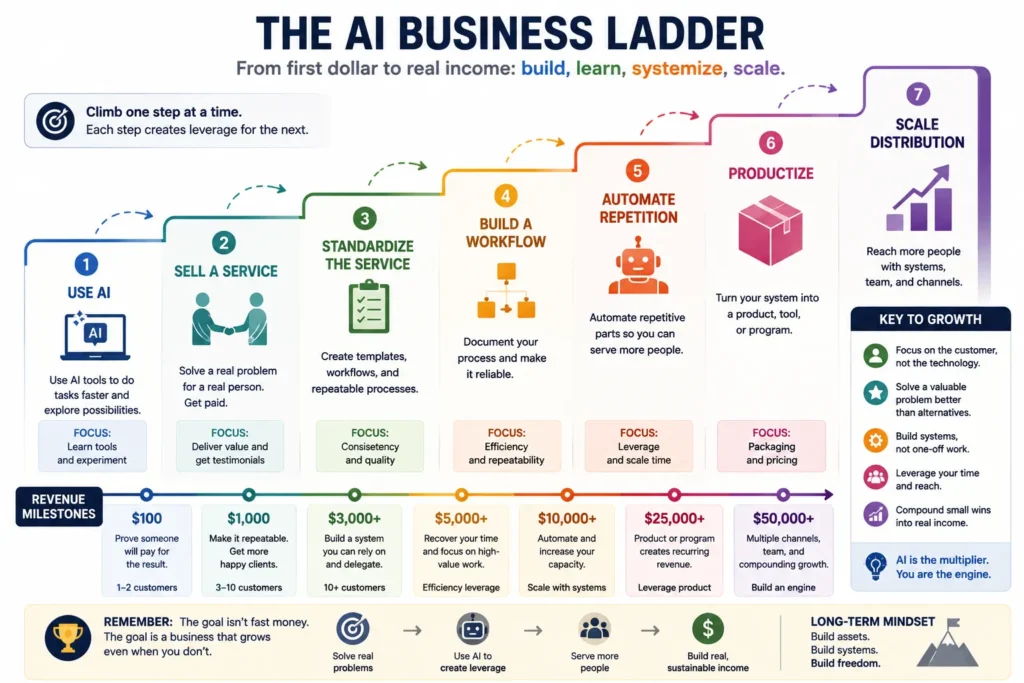
I think there’s a useful progression here.
Use AI
↓
Sell a Service
↓
Standardize the Service
↓
Build a Workflow
↓
Automate Repetition
↓
Productize
↓
Scale Distribution
You don’t have to climb the entire ladder.
A profitable freelance business can be excellent.
But understanding where you are prevents you from confusing a tool with a business model.
Five AI Opportunities I’d Take Seriously
If I were starting today, these are the categories I’d investigate first.
1. AI-Enhanced Professional Services
Probably the most realistic starting point for many people.
Take something businesses already purchase.
Improve delivery with AI.
Marketing.
Design.
Video.
Research.
Presentations.
Translation.
Development.
The demand already exists.
You don’t have to convince customers that the problem is real.
2. Small-Business Automation
Many small companies still operate through:
- email,
- spreadsheets,
- messaging apps,
- repetitive manual processes.
You don’t need to automate the entire company.
One painful workflow can be enough.
For example:
Customer inquiry
→ classify
→ draft response
→ update CRM
→ schedule follow-up
→ alert human when necessary.
The value isn’t:
Look at this AI agent.
The value is:
Your employees no longer spend two hours every morning doing this manually.
3. Specialized Content Businesses
I’m still interested in AI-assisted content.
I’m just not interested in mass-producing generic content.
A specialized publication with:
- genuine expertise,
- original testing,
- useful tools,
- strong editorial judgment,
- consistent quality,
can use AI to dramatically improve production.
Research faster.
Analyze more.
Create supporting visuals.
Update old content.
Repurpose useful material.
But the publication still needs a reason to exist.
AI should increase the quality or efficiency of the editorial operation.
Not replace the editorial operation.
4. Vertical AI Tools
Generic AI is incredibly capable.
But generic capability can create friction.
A lawyer doesn’t necessarily want to design prompts every day.
A teacher doesn’t want to build an AI workflow from scratch.
A real-estate agent may not care which model powers the system.
They want:
Upload this → get the thing I need.
That’s the opportunity behind vertical AI.
Take a narrow workflow.
Understand it deeply.
Remove the complexity.
Charge for the result.
5. AI Education and Implementation
Every major technological shift creates a gap between:
What the technology can do
and
What normal organizations know how to do with it.
That gap creates opportunity.
But generic:
Learn ChatGPT!
training will become less valuable.
More useful education is specific.
AI for accountants.
AI for architects.
AI for teachers.
AI for sales teams.
AI for manufacturing procurement.
The closer training gets to actual work, the more defensible it becomes.
What I Would Avoid
There are several AI income ideas I’d approach cautiously.
Mass-Generated SEO Sites
If the strategy is:
Publish thousands of inexpensive AI articles and wait for traffic.
You’re building a business around abundance.
That’s not where I’d want to compete.
Generic Prompt Packs
Unless the prompts are part of a genuinely valuable system, they’re increasingly easy to reproduce.
Copycat AI Art Stores
Possible.
But extremely easy to enter and therefore difficult to defend without audience, brand, or specialization.
“Fully Automated” Social Channels
Automation can reduce production costs.
It doesn’t guarantee anyone wants to watch.
AI Courses About Making Money With AI
There’s an obvious circularity here.
If the primary proven way someone makes money with an AI side hustle is teaching other people how to make money with that side hustle, I’d investigate carefully.
The Copy Test
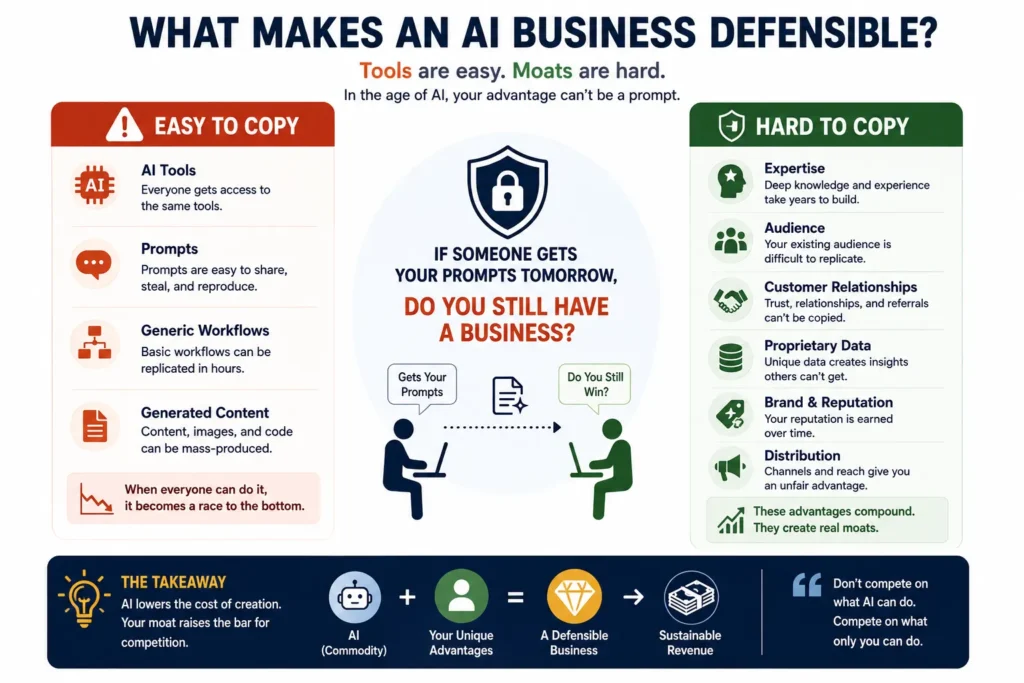
Here’s another framework I’d use.
Imagine a competitor gets access to:
- your AI tools,
- your prompts,
- your workflow.
Could they recreate your business in one weekend?
If yes, you don’t have much of a moat.
Now imagine they would also need:
- your audience,
- industry experience,
- customer relationships,
- proprietary data,
- brand,
- reputation,
- distribution.
Much better.
AI tools are becoming commodities remarkably quickly.
Build your advantage somewhere else.
The 30-Day Test I’d Actually Run
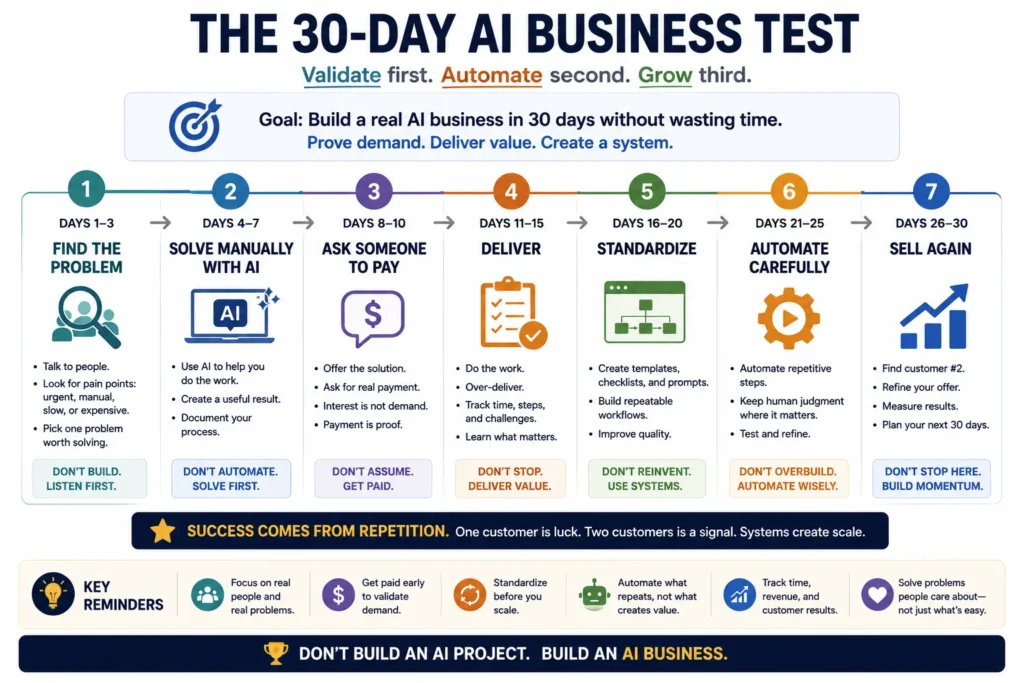
If I wanted to test an AI business idea without wasting six months, I’d do this.
Days 1–3: Find the Problem
Talk to people.
Don’t build anything.
Look for something:
- repetitive,
- expensive,
- annoying,
- slow,
- already being paid for.
Days 4–7: Solve It Manually With AI
Don’t automate yet.
Use AI behind the scenes.
See whether you can actually create a useful result.
Days 8–10: Ask Someone to Pay
This is the uncomfortable step.
It’s also the important one.
Don’t ask:
Do you like my idea?
Ask:
Would you pay €100 for me to solve this?
Interest is not demand.
Payment is much better evidence.
Days 11–15: Deliver
Do the work.
Watch where your time goes.
Which steps are repetitive?
Which require judgment?
Which cause mistakes?
Days 16–20: Standardize
Create:
- templates,
- checklists,
- prompts,
- workflows,
- quality controls.
Now you’re building a system.
Days 21–25: Automate Carefully
Automate the repetitive parts.
Not the parts customers are paying you to think about.
Days 26–30: Sell Again
Find customer number two.
This is the real test.
One customer may be luck.
Two begins to suggest repeatability.
Don’t Automate Before Someone Cares
This deserves its own section because AI makes premature automation incredibly tempting.
You can spend a week building:
- agents,
- databases,
- workflows,
- integrations,
- dashboards.
Everything works beautifully.
Except nobody wants it.
Start ugly.
Solve the problem manually.
Use AI privately.
Get paid.
Then automate what repeatedly hurts.
The same rule applies to AI work more broadly: delegate repetitive execution without giving up the human judgment customers are actually paying for.
That’s slower technologically.
It’s often faster commercially.
The Metric I’d Use: Revenue per Human Hour
AI businesses love measuring output.
Articles generated.
Images produced.
Emails sent.
Automations executed.
I care more about another metric:
Revenue per Human Hour.
Imagine Business A generates 1,000 AI images every month and earns $300.
Business B produces five specialized client reports and earns $5,000.
Which business is using AI more effectively?
Output doesn’t tell us.
Revenue alone doesn’t tell us either.
The useful question is how AI changes the economics of human effort.
If AI allows you to deliver $2,000 of customer value while requiring three hours of your attention instead of fifteen, that’s meaningful leverage.
There’s Another Metric: Customer Value per AI Dollar
Don’t optimize only for cheap AI.
Suppose Workflow A costs $2 in model usage but creates a mediocre result.
Workflow B costs $20 but helps you deliver something a customer happily pays $1,000 for.
The expensive AI is cheaper.
This is the same mistake people make when comparing AI video credits or generation prices.
Cost without outcome is almost meaningless.
Optimize the entire business.
Not the API bill in isolation.
AI Doesn’t Have to Be Visible
This may be one of the biggest opportunities.
The best AI business may not advertise itself as an AI business at all.
Imagine a research company that delivers reports twice as quickly because AI helps analyze documents.
A design studio that explores 100 concepts before presenting three.
A video company that creates storyboards and rough scenes with generative tools.
A consultant who uses AI to analyze thousands of customer comments.
Customers may never care how the internal workflow works.
They care that the outcome is:
- faster,
- better,
- cheaper,
- more thorough.
AI becomes infrastructure.
That’s when the technology starts feeling mature.
The Question I’d Ask Before Starting
Not:
How can I make money with AI?
Ask:
What valuable thing can I do that becomes dramatically easier because AI exists?
That’s a much harder question.
It’s also much more likely to produce a real business.
Maybe you already know an industry.
Maybe you already have an audience.
Maybe you’re already good at video.
Writing.
Design.
Programming.
Teaching.
Sales.
Research.
Start there.
AI doesn’t require you to abandon what you know.
Often the best opportunity is multiplying it.
Final Thoughts
Yes, you can make money with AI in 2026.
People already do.
But I don’t think the biggest opportunity is discovering some secret prompt that prints money while you sleep.
It’s much more ordinary.
And much more powerful.
AI reduces the cost of doing certain kinds of work.
That means one person can:
research more,
create more,
test more,
serve more customers,
build things that previously required a team.
That’s real leverage.
But leverage isn’t value.
The customer still decides whether the result matters.
So if you’re looking for an AI business idea, don’t spend your first week comparing models.
Spend it looking for pain.
Find someone wasting time.
Find a business losing money.
Find a task people hate.
Find information that’s difficult to understand.
Find something people already wish worked better.
Then ask:
Can AI help me solve this dramatically better?
If the answer is yes, build the smallest version.
Try to sell it.
Listen.
Improve it.
Only then automate.
Because the most valuable AI entrepreneurs probably won’t be the people who know the most prompts.
They’ll be the people who understand something much older than AI:
People pay for problems to disappear.
AI just gives us new ways to make that happen.
Frequently Asked Questions
Can you really make money with AI?
Yes, but AI doesn’t automatically create a viable business. The strongest opportunities usually combine AI with an existing customer problem, valuable skill, domain expertise, audience, distribution channel, or proprietary information.
What is the easiest way to make money with AI?
For many people, AI-enhanced freelancing or services may be easier to validate than building a product from scratch because customers already pay for writing, design, research, development, video, marketing, and other professional outcomes.
Can I make passive income with AI?
AI can automate parts of a business, but genuinely passive income is much harder than social media often suggests. Products still need demand, distribution, maintenance, customer acquisition, and differentiation.
Is starting an AI agency still worth it?
Potentially, but “AI agency” isn’t a strong customer proposition by itself. A better business clearly explains the outcome it creates, such as reducing support workload, improving lead follow-up, or automating a repetitive reporting process.
Can AI-generated content make money?
Yes, but simply generating large amounts of content is not a durable advantage. Specialized expertise, original information, strong editorial judgment, audience trust, and distribution become increasingly important as content production gets cheaper.
What AI side hustles should beginners avoid?
Be cautious with opportunities whose only advantage is that they’re easy to generate, such as undifferentiated prompt packs, mass-produced generic content, or copycat AI products. Low barriers usually attract competition quickly.
What’s the best way to start an AI business?
Start with a real customer problem, solve it manually with AI, ask someone to pay for the outcome, learn from delivery, standardize the workflow, and automate only after you’ve demonstrated demand.