
A question keeps appearing everywhere.
“Which AI is better?”
Sometimes it’s ChatGPT versus Claude.
Sometimes it’s Claude versus Gemini.
Sometimes people ask which one is “the smartest.”
I understand why.
If you’re paying for an AI assistant, you naturally want to choose the best one.
The problem is that the question itself is slightly wrong.
Because asking,
“Which AI is best?”
is a little like asking,
“Which employee is best?”
Best at what?
Writing?
Research?
Programming?
Teaching?
Negotiation?
The answer changes immediately.
The same thing happens with AI.
The Mistake Most People Make
Imagine hiring someone for your company.
Candidate A writes exceptional reports.
Candidate B analyzes complicated financial data faster than anyone else.
Candidate C explains difficult concepts so clearly that every new employee understands them.
Which one is the best employee?
You can’t answer that question until you know the job.
Oddly enough, that’s exactly how people compare AI.
They expect one model to outperform every other model in every possible task.
That’s rarely how modern AI works.
Different models are trained, optimized, and improved with different priorities.
Understanding those priorities matters far more than memorizing benchmark scores.
Why ChatGPT and Claude Feel Different
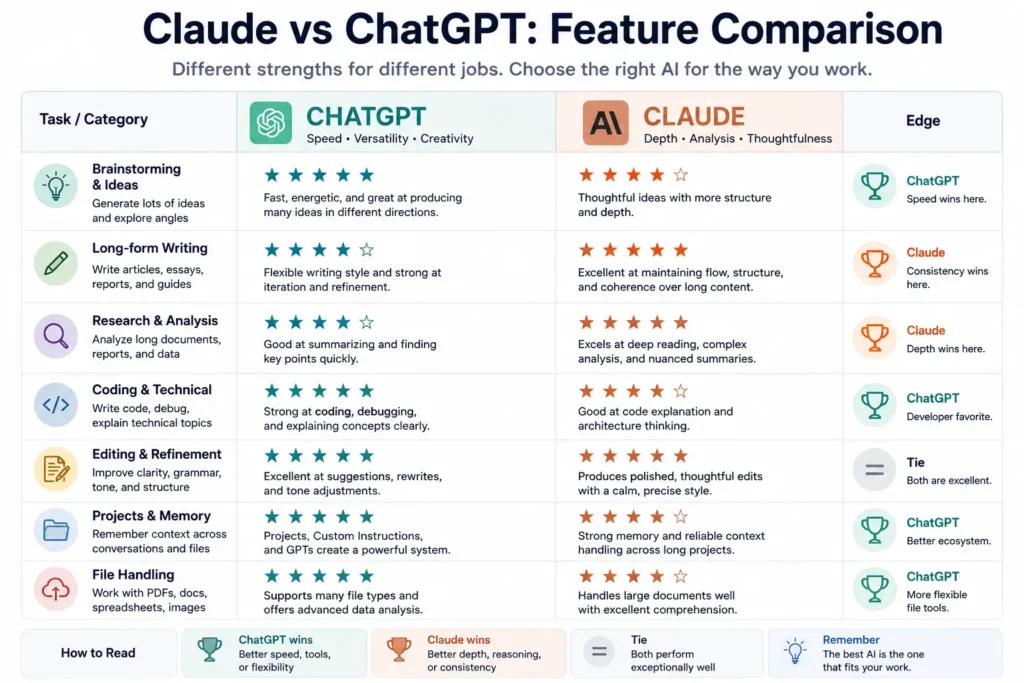
If you’ve spent enough time using both, you’ve probably noticed something.
They don’t simply give different answers.
They often think differently.
Ask both systems to summarize a document.
The answers may look similar.
Ask both systems to rewrite a complex article.
The differences become much easier to notice.
ChatGPT often feels energetic.
Fast.
Flexible.
Comfortable switching between different tasks.
Claude often feels more deliberate.
It spends more time building structure.
Long explanations tend to feel calmer and more methodical.
Neither style is automatically better.
They’re simply different.
And that difference becomes important depending on what you’re trying to accomplish.
A Better Way to Compare AI
Instead of asking,
“Which model wins?”
I’ve started asking something else.
“Which model would I hire for this specific job?”
That question produces much more useful answers.
Suppose I need help brainstorming twenty content ideas.
Would I choose the same assistant I’d ask to review a fifty-page research paper?
Probably not.
Suppose I need help writing Python code.
Would I automatically choose the same assistant I’d use for editing a marketing campaign?
Again, probably not.
The job changes.
The ideal assistant changes too.
A Real Example
Imagine two people sitting at different desks.
The first is a marketing manager.
They need:
- blog ideas,
- email campaigns,
- social media captions,
- product descriptions,
- quick revisions.
Speed matters.
Creativity matters.
Iteration matters.
Across the room sits a policy analyst.
Their day looks completely different.
They spend hours reading reports.
Comparing documents.
Identifying contradictions.
Summarizing hundreds of pages.
Accuracy matters.
Structure matters.
Consistency matters.
Now imagine giving both people exactly the same AI assistant.
Could it work?
Of course.
Would it always be the best choice?
Probably not.
That’s the mistake many comparison articles make.
They compare models.
They rarely compare work.
The Wrong Question Creates the Wrong Winner
Search the internet for AI comparisons and you’ll find the same conclusion repeated over and over.
“ChatGPT wins.”
Or,
“Claude is better.”
Sometimes both articles appear on the same day.
How is that possible?
Because the criteria keep changing.
One review focuses on coding.
Another measures creative writing.
A third tests mathematical reasoning.
A fourth compares document analysis.
Every reviewer chooses different tasks.
Every task rewards different strengths.
Then readers are left wondering why the rankings seem to change every month.
The models didn’t necessarily become worse.
The questions simply changed.
How I’m Going to Compare Them
Rather than declaring one universal winner, let’s treat ChatGPT and Claude the way a hiring manager evaluates candidates.
We’ll ask practical questions.
Which assistant would you choose for:
- writing long articles,
- analyzing research,
- coding,
- studying,
- business planning,
- brainstorming,
- editing,
- long-term projects?
Each task rewards different abilities.
Some categories may have a clear winner.
Others may end in a draw.
And in some situations, the smartest answer won’t be choosing one model at all.
It will be using both together.
Because once you stop searching for the single best AI and start searching for the right AI for the right job, the entire comparison begins to make much more sense.
Comparing AI by Real Work, Not Marketing
Benchmarks are useful.
Leaderboards are interesting.
But neither tells you what happens on a normal Tuesday at work.
Most people don’t spend their day solving benchmark questions.
They write emails.
Review documents.
Analyze reports.
Brainstorm ideas.
Edit presentations.
Prepare meeting notes.
That’s where an AI assistant either becomes genuinely valuable—or quietly disappointing.
So instead of asking which model scores higher on a particular test, let’s compare them in situations that millions of people actually face.
Writing Long Articles
Suppose you’re writing a 4,000-word guide.
Not a social media caption.
Not a short email.
A complete article that needs structure, consistency, and a logical flow from beginning to end.
This is where Claude often feels particularly comfortable.
Long-form writing tends to remain organized, calm, and consistent.
Sections connect naturally.
The overall structure usually stays intact.
ChatGPT performs well too, especially when you iterate with it.
It often generates ideas more quickly and is excellent for rewriting, expanding, or experimenting with different directions.
If my goal is producing a polished first draft of a long article, I’d often lean toward Claude.
If my goal is improving, reshaping, and refining that article through multiple revisions, ChatGPT becomes extremely compelling.
The winner depends on the stage of the work.
Research and Document Analysis
Now imagine receiving a 70-page report.
Your job isn’t to rewrite it.
Your job is to understand it.
Summarize the key findings.
Identify contradictions.
Highlight risks.
Connect ideas across multiple sections.
This type of work rewards careful reading more than creativity.
Claude has developed a strong reputation for handling long documents and producing structured summaries that preserve context across extended texts.
ChatGPT is also highly capable, particularly when combined with uploaded documents, Projects, and retrieval-based workflows.
But the experience often feels different.
Claude tends to read like a patient analyst.
ChatGPT often feels more like an energetic collaborator.
Neither approach is wrong.
They’re simply optimized for different working styles.
Brainstorming and Creative Work
Now let’s change jobs completely.
You’re launching a new product.
You need:
- twenty blog ideas,
- ten YouTube titles,
- email subject lines,
- landing-page headlines,
- social media hooks.
Perfection isn’t the priority.
Momentum is.
This is an area where ChatGPT often feels exceptionally strong.
It encourages iteration.
You can rapidly explore different angles, tones, audiences, and formats.
The conversation becomes highly interactive.
Claude is perfectly capable of creative work as well.
Its suggestions often feel more deliberate and measured.
For many marketing teams, that’s actually an advantage.
The important point is that creativity has more than one style.
Some teams want rapid idea generation.
Others want thoughtful refinement.
Coding and Technical Work
Software development is another category where sweeping conclusions become misleading.
Neither model is perfect.
Both occasionally produce bugs.
Both occasionally misunderstand requirements.
The quality of your prompt often matters more than the logo at the top of the screen.
For many developers, ChatGPT integrates naturally into broader workflows that involve coding assistants, APIs, and development tools.
Claude is also widely used for programming tasks and is frequently praised for explaining code in a clear, structured way.
The strongest developers I know rarely rely on one model alone.
They compare.
Test.
Review.
Verify.
Exactly as they would with another engineer.
A Better Strategy Than Choosing Sides
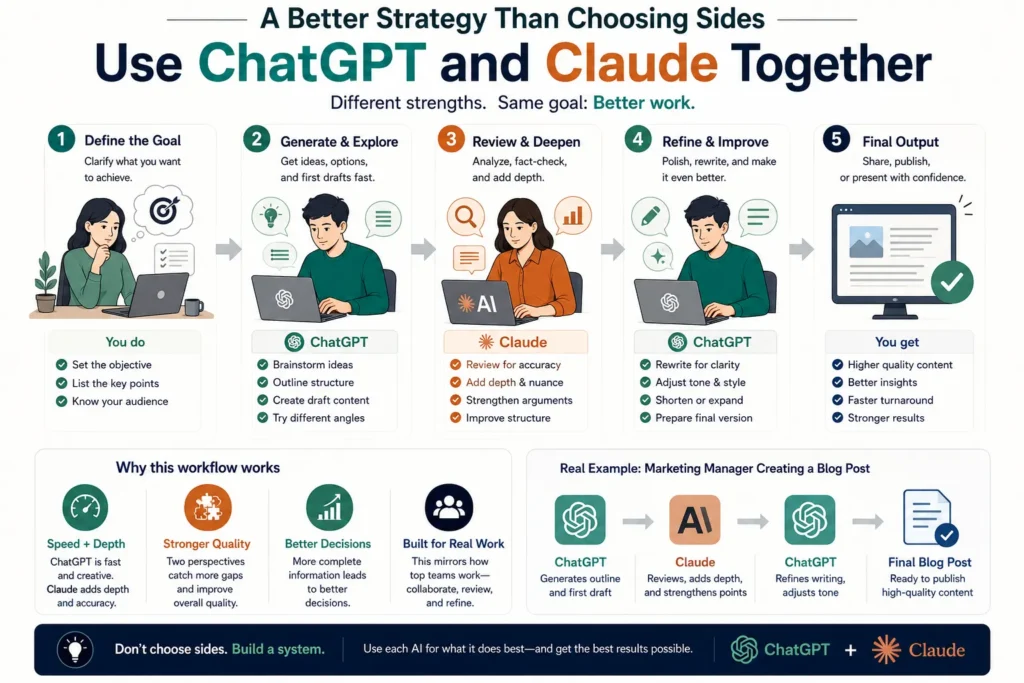
This is the point where many comparison articles declare a winner.
I think that’s a mistake.
Imagine running a business.
Would you hire only one employee because they’re “the best”?
Probably not.
You’d build a team.
One person writes.
Another analyzes.
Another reviews.
Another manages projects.
Modern AI works surprisingly well in the same way.
Many professionals now use ChatGPT for rapid ideation and workflow management, then switch to Claude for reviewing, restructuring, or analyzing long documents.
The workflow matters more than the logo.
Which AI Fits Your Work?
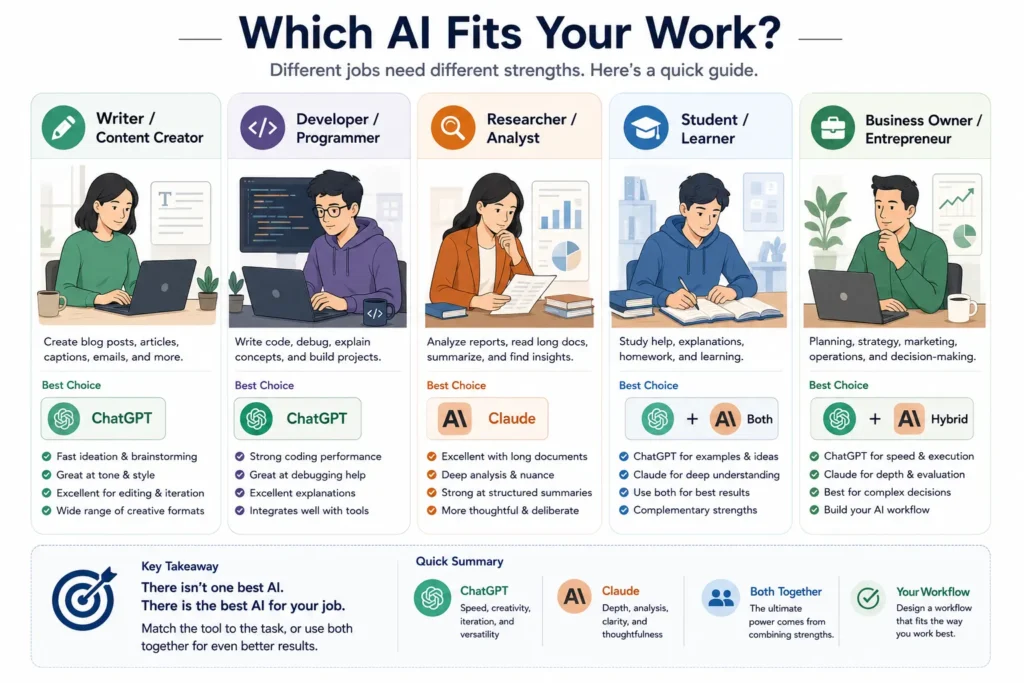
Rather than ranking the models from first to second, here’s how I think about them.
Content Creators
If your day revolves around brainstorming, rewriting, editing, and publishing content quickly, ChatGPT is often an excellent choice.
Researchers and Analysts
If your work involves reading lengthy reports, comparing evidence, and producing structured summaries, Claude is often particularly comfortable.
Students
Both are valuable.
Use ChatGPT to explore ideas, practice concepts, and generate examples.
Use Claude to review long reading assignments and organize complex material.
Business Owners
Don’t think in terms of competition.
Think in terms of workflow.
One model generates.
The other critiques.
One explores possibilities.
The other improves clarity.
That combination is often stronger than either model alone.
What Actually Matters
People spend a surprising amount of time debating which AI is “smarter.”
In practice, most professionals care about something much simpler.
Can it help me finish today’s work faster?
Can I trust the answer?
Will it save me time next week?
Does it fit the way I already work?
Those questions produce much better decisions than benchmark charts.
Before You Choose
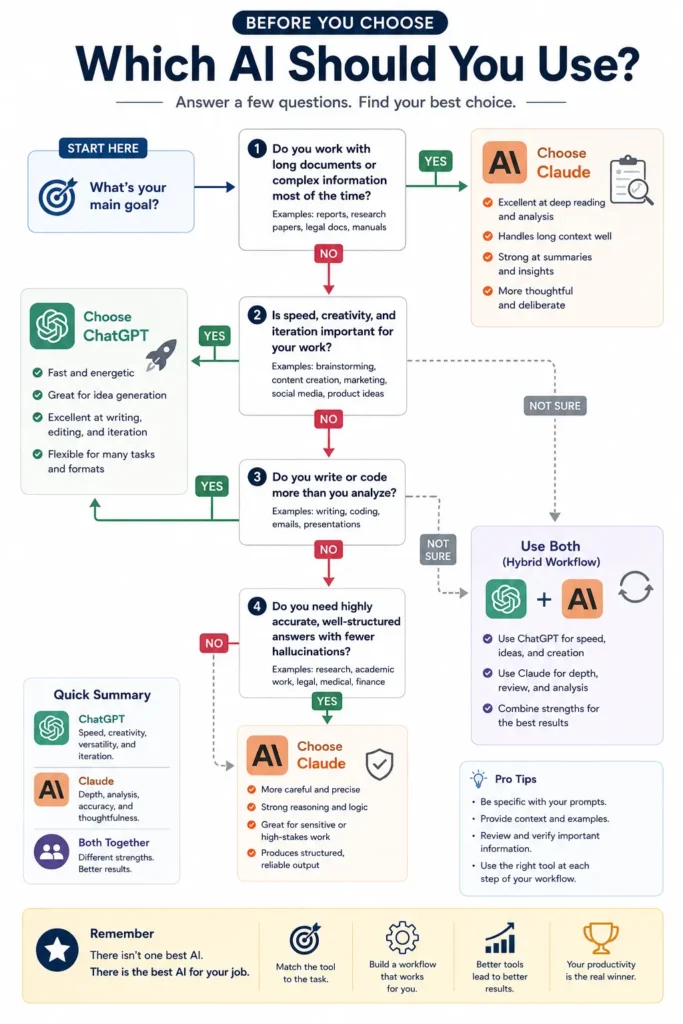
Before paying for any AI subscription, ask yourself:
- What do I spend most of my day doing?
- Do I write more than I research?
- Do I analyze more than I brainstorm?
- Do I work with long documents?
- Do I need rapid iteration?
- Will one assistant be enough, or would two complementary tools create a better workflow?
Those answers usually point toward the right choice.
Much more reliably than internet rankings.
Final Thoughts
I don’t think the future belongs to one AI model.
It belongs to people who know how to use different models for different kinds of work.
The best photographer doesn’t use one lens for every situation.
The best carpenter doesn’t use one tool for every job.
And the most productive AI users rarely rely on a single assistant simply because someone declared it “the winner.”
They understand the strengths of each tool.
Then they build workflows around those strengths.
That’s a much more practical way to think about AI.
Because the real goal was never to find the smartest chatbot.
The goal was to do better work.
If one model helps you write faster, another helps you think more deeply, and together they improve the quality of your decisions, then you don’t really have a winner.
You have a system.
And in the long run, well-designed systems almost always outperform individual tools.
Frequently Asked Questions
Which AI is better overall?
There isn’t a universal winner. The better choice depends on what you’re trying to accomplish.
Which AI is better for writing?
For many users, Claude excels at producing structured long-form drafts, while ChatGPT shines during brainstorming, editing, and rapid iteration.
Which AI is better for research?
Both are capable, but many people prefer Claude for reading and organizing long documents, while ChatGPT performs especially well when combined with projects, uploaded files, and broader workflows.
Should I subscribe to both?
If AI plays an important role in your daily work, many professionals find value in using both for different stages of the same workflow. If you use AI only occasionally, one subscription is often enough.