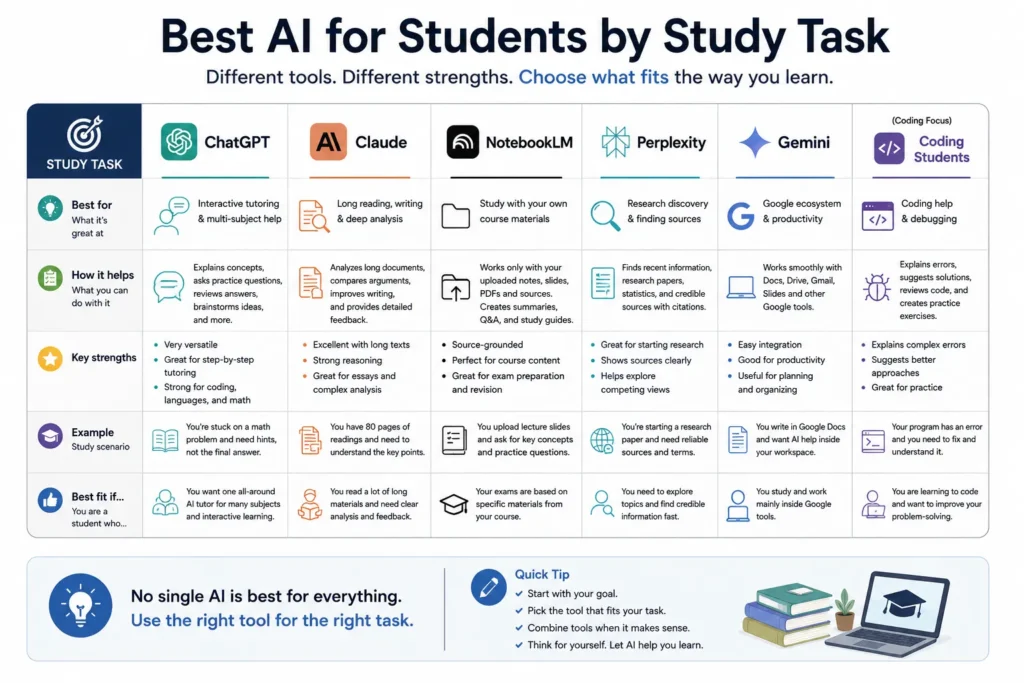
The more your study involves sitting with long material and pulling arguments apart, the more valuable that style of assistant becomes.
The Student I Would Recommend NotebookLM To
NotebookLM becomes especially attractive when the exam is based on a defined collection of material.
Your professor gives you:
slides,
lecture notes,
PDFs,
readings,
handouts.
You don’t necessarily need the entire internet.
You need to understand those materials.
That’s where source-grounded studying becomes powerful.
The Student I Would Recommend Perplexity To
I’d consider Perplexity when the problem begins with:
I don’t know where to start researching this.
It can help map the topic and surface sources quickly.
But I wouldn’t treat the generated answer as the finished research.
Think of it as the entrance to the library.
Not the book you cite without opening.
What About Gemini?
Gemini deserves consideration too, particularly for students already working heavily inside Google’s ecosystem.
If your academic life already revolves around Google Docs, Drive, Gmail, and other Google services, integration can matter as much as raw model capability.
This is another reason universal rankings are misleading.
The best AI isn’t always the one that wins an isolated prompt test.
Sometimes it’s the one that fits naturally into the environment where you already study.
Free AI vs Paid AI for Students
Here’s where I’d resist another common temptation.
Don’t subscribe simply because the paid model is more powerful.
Start free.
Use AI for real studying for several weeks.
Notice where you actually hit limitations.
Maybe you need:
more usage,
better document handling,
stronger models,
longer workflows,
additional research features.
Then consider paying.
A subscription makes sense when it removes a real limitation you repeatedly encounter.
Not when you’re paying because everyone online says you need the premium version.
For many students, free access to one or more capable AI tools may already be enough.
When I Would Not Use AI
There are moments when I would close it completely.
Before forming an opinion
If the assignment asks what you think, give yourself a few minutes to think first.
During recall practice
If you’re testing whether you remember something, looking at AI defeats the purpose.
When learning a foundational skill
Sometimes struggling through the process is the lesson.
During assessments where AI isn’t permitted
Obvious, but important.
Academic rules vary by school, course, and instructor.
When you notice yourself copying before reading
That’s a warning sign.
The AI has stopped being a study tool.
It’s becoming a substitute for participation.
The One Prompt I Wish More Students Used
If I could give students only one AI prompt, it wouldn’t be an elaborate prompt template.
It would be this:
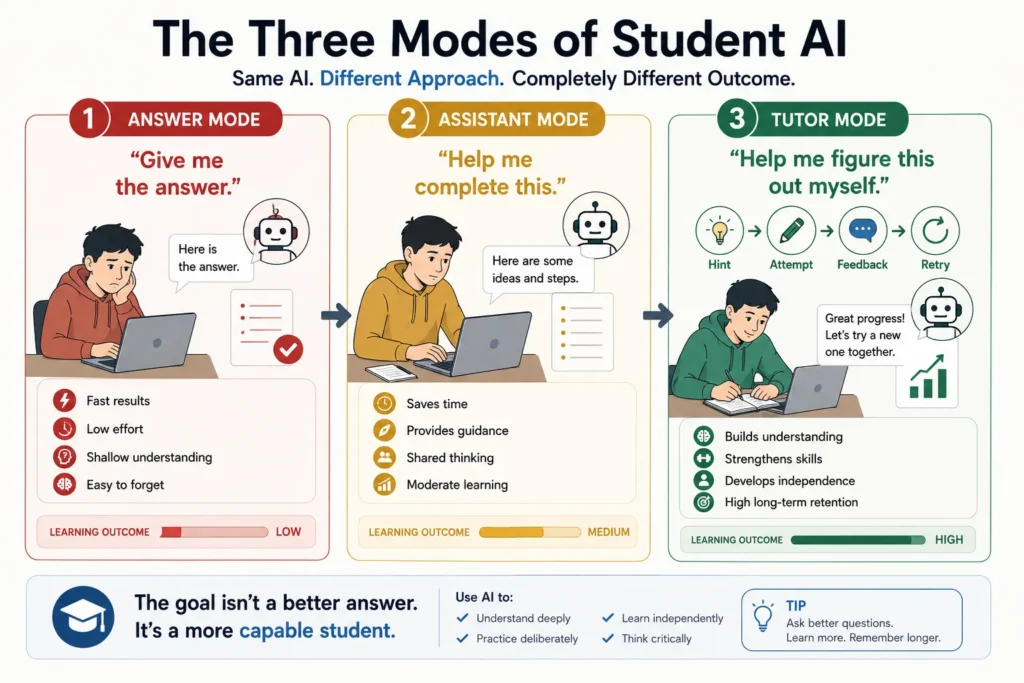
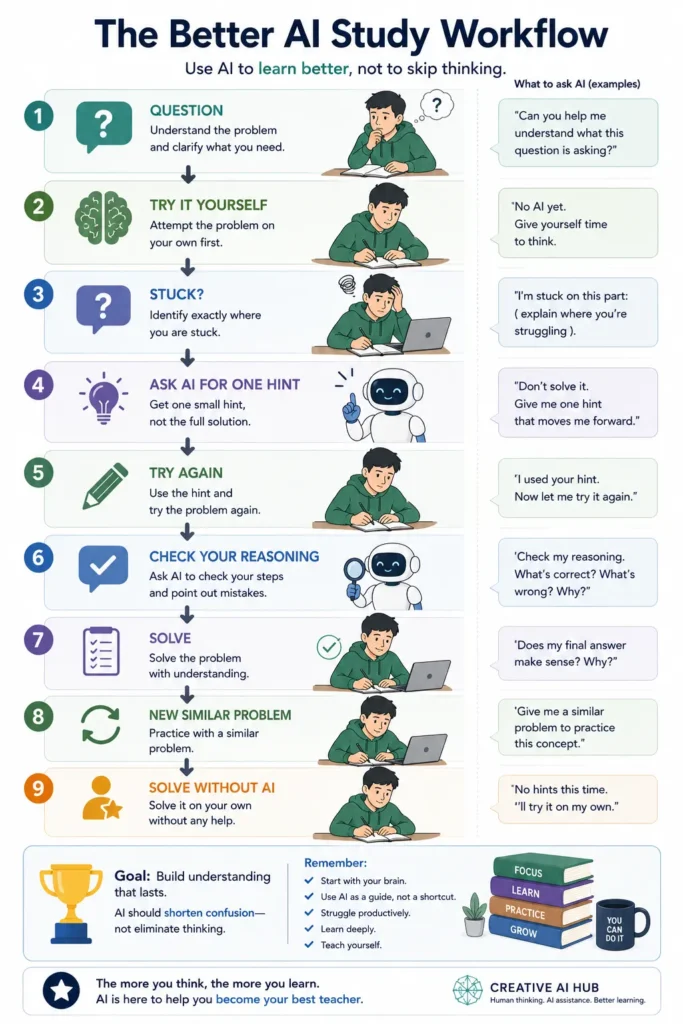
Don’t give me the answer yet. Help me figure it out myself.
Then continue the conversation.
Give me one hint.
Ask me what I already know.
Tell me where my reasoning went wrong.
Give me an easier example.
Test me again without showing the solution.
Those prompts turn almost any capable AI into a much better learning tool.
Not because the model changes.
Because your relationship with it does.
My Practical Recommendation
If you’re choosing today, I would think about it this way.
Choose ChatGPT if…
You want one flexible AI for many subjects and highly interactive tutoring.
Choose Claude if…
Long reading, writing, and careful document analysis dominate your workload.
Choose NotebookLM if…
Your learning revolves around a defined set of course materials.
Choose Perplexity if…
Research discovery and finding sources are frequent parts of your work.
Consider Gemini if…
Your study workflow already lives heavily inside Google’s ecosystem.
Use more than one if…
You have a genuine reason.
Research with one.
Read with another.
Practice with another.
But don’t collect AI subscriptions like stationery.
More tools don’t automatically create more learning.
A Better Way to Measure AI for Students
Forget for a moment about:
model rankings,
benchmark scores,
token limits,
feature counts.
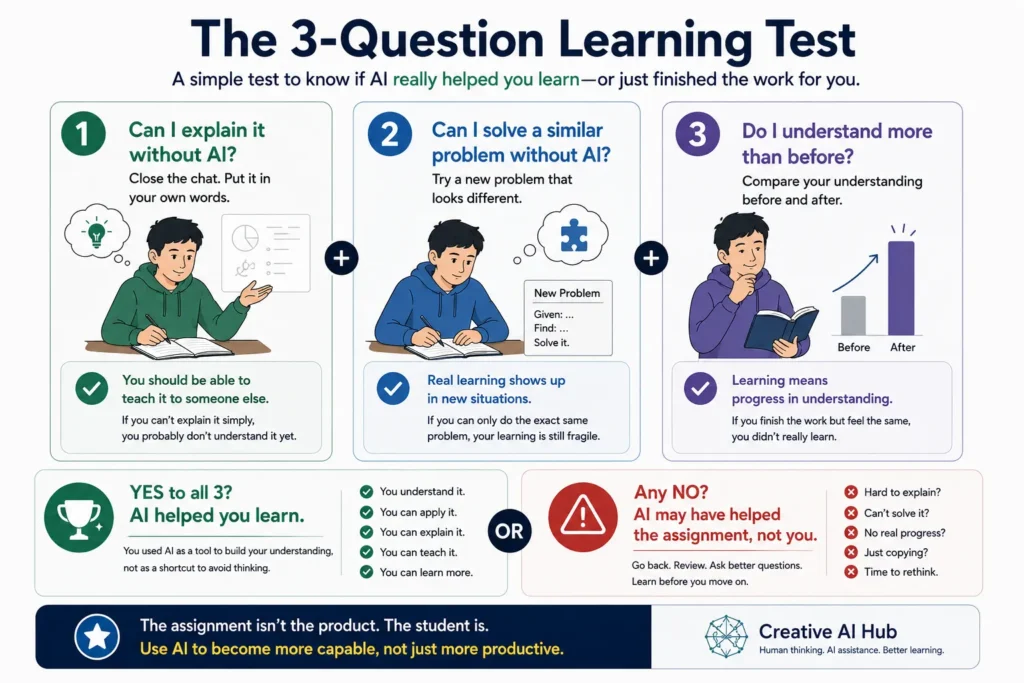
At the end of a study session, ask yourself three questions.
Can I explain this without AI?
Can I solve a similar problem without AI?
Do I understand more than I did before I opened AI?
If the answer is yes, the tool probably helped.
If the only thing that improved was the quality of the assignment sitting on your screen, I’d be more cautious.
Because the assignment isn’t the product of education.
The student is.
Final Thoughts
AI may become one of the most powerful educational tools we’ve ever had.
A private tutor that is available at midnight.
A conversation partner for a language nobody around you speaks.
A coding assistant that can explain an error twenty different ways.
A research guide that can help you find the first path into an unfamiliar subject.
That’s extraordinary.
But the same technology can also make it incredibly easy to skip the exact mental work education is supposed to develop.
The difference isn’t simply which AI you choose.
It’s what you ask it to do.
Ask it to replace the difficult parts and you’ll finish faster.
Ask it to help you through the difficult parts and you may actually become better.
For students, that’s the comparison that matters most.
Not:
Which AI gives the best answer?
But:
Which way of using AI leaves me more capable when the screen is closed?
Choose your tools around that question and the rankings become much less important.
Learning becomes the point again.
Frequently Asked Questions
What is the best AI for students in 2026?
There isn’t one best option for every student. ChatGPT is a strong general-purpose choice, Claude can be useful for long documents and writing, NotebookLM is valuable for source-based studying, Perplexity can help with research discovery, and Gemini may suit students working heavily in Google’s ecosystem.
Is ChatGPT or Claude better for students?
It depends on the work. ChatGPT is particularly versatile for interactive tutoring and switching between subjects, while Claude can be attractive for long reading, analysis, and writing-heavy study.
Is NotebookLM better than ChatGPT for studying?
For studying a fixed collection of course materials, NotebookLM can have an important advantage because the workflow centers on the sources you provide. For broader tutoring and interactive practice across many subjects, ChatGPT may be more flexible.
Can students use AI without hurting their learning?
Yes, but the method matters. Asking for hints, feedback, explanations, practice questions, and challenges preserves much more of the learning process than simply requesting finished answers.
Should students pay for AI?
Not automatically. Start with free options and pay only when you repeatedly encounter a limitation that materially affects your studying.