Where AI Should Help—and Where You Should Still Do the Work
I once watched someone use AI to write an email.
Nothing unusual about that.
They explained the situation, asked for a professional reply, copied the result, and sent it.
The whole thing took less than two minutes.
Then I asked a simple question.
“Do you agree with what it says?”
There was a pause.
They opened the email again.
Read it from the beginning.
And changed two paragraphs.
That moment has stayed with me because it captures something we’re going to encounter more often as AI gets better.
The danger isn’t that AI will become terrible at our work.
It’s that it will become good enough that we stop checking whether the work still represents us.
AI Has Made Starting Almost Too Easy
A blank page used to create friction.
You had to decide what you thought before you could explain it.
Now you can type:
“Write a proposal.”
And there it is.
A title.
An introduction.
Five recommendations.
A conclusion.
Thirty seconds earlier, nothing existed.
That feels like progress.
Most of the time, it is.
But I’ve started noticing a strange side effect.
When AI gives us a finished answer too early, it can quietly remove the moment when we would normally decide what we think.
That’s a very different problem from hallucinations or factual errors.
The answer can be perfectly written.
It can even be correct.
And still make us intellectually lazy.
The Most Useful AI Workflow I’ve Found Starts Before the Prompt
When I have an important problem to solve, I try not to begin by asking AI for the answer.
I begin with my own position.
Sometimes it’s only three sentences.
What do I think is happening?
What am I uncertain about?
What would change my mind?
Only then does AI enter the process.
This sounds slower.
In practice, I’ve found the opposite.
Because once I have a position, AI becomes something much more valuable than an answer generator.
It becomes opposition.
I can ask:
“What’s wrong with this argument?”
“What am I overlooking?”
“Make the strongest case against my conclusion.”
“Which assumption here is weakest?”
Those conversations are far more useful than:
“Tell me what I should think.”
The difference is subtle.
In one workflow, AI replaces thinking.
In the other, it creates pressure that improves thinking.
The 80% Problem
AI is remarkably good at producing work that feels 80 percent finished.
That’s one of its greatest strengths.
It’s also one of its biggest traps.
An AI-generated report may have:
- a logical structure,
- professional language,
- reasonable arguments,
- useful examples,
- a convincing conclusion.
Everything looks right.
So we accept it.
But the final 20 percent is often where the actual value lives.
Which argument matters most?
Which recommendation would I personally defend in a meeting?
Which fact changes the decision?
Which paragraph sounds impressive but says almost nothing?
Those questions require judgment.
AI can help answer them.
It shouldn’t be allowed to make them invisible.
A Realistic Business Decision
Imagine you’re choosing between two suppliers.
Supplier A is 12 percent cheaper.
Supplier B has a better delivery record.
You have a deadline that cannot easily move.
So you ask AI:
Which supplier should I choose?
AI can produce a beautiful analysis.
Price.
Risk.
Schedule.
Quality.
Maybe even a weighted scoring model.
But something important is missing.
What happens if delivery is late?
Perhaps a two-week delay costs almost nothing.
In that case, Supplier A may be perfectly reasonable.
Perhaps a two-week delay shuts down an entire production line.
Now that 12 percent saving looks very different.
The AI doesn’t automatically know which consequence your organization can tolerate.
That’s not an information problem.
It’s a judgment problem.
Use AI to Expand the Decision, Not Make It
For decisions like that, I prefer a different workflow.
Instead of asking:
“Which supplier should I choose?”
ask:
“What variables should I consider before choosing between these suppliers?”
Now AI may surface:
- price,
- delivery reliability,
- quality history,
- capacity,
- financial stability,
- geographic risk,
- contract terms,
- switching costs.
That’s useful.
Then ask:
“What would have to be true for Supplier A to be the better choice?”
And then:
“What would have to go wrong for that decision to become expensive?”
Now we’re doing something much more interesting.
AI isn’t making the decision.
It’s increasing the surface area of the decision.
The final judgment still belongs to the person who understands the consequences.
Research Is Where This Gets Dangerous
Research feels like one of the most natural uses for AI.
Ask a question.
Receive an explanation.
Continue working.
The problem is that fluent answers create an illusion of completed research.
A polished paragraph feels researched even when you haven’t looked at the evidence.
I’ve learned to separate two jobs.
AI can help me discover what I should investigate.
Evidence determines what I should believe.
That distinction matters.
If AI tells me a regulation changed, I want the regulation.
If it gives me a statistic, I want the original source.
If it describes what a company announced, I want the announcement.
AI is extraordinarily useful for navigating information.
But navigation isn’t verification.
Writing Has the Opposite Problem
Research risks making us believe things too quickly.
Writing risks making us say things we never really thought.
Ask AI to write an article about almost anything and it will produce something competent.
That’s exactly why the temptation is dangerous.
The grammar may be better than yours.
The structure may be cleaner.
The transitions may be smoother.
But writing isn’t valuable because the sentences are smooth.
Writing becomes valuable when someone made a decision about what deserves to be said.
That’s why I increasingly prefer giving AI messy thinking rather than an empty page.
Notes.
Arguments.
Questions.
Contradictions.
Observations.
Then I ask it to help me structure them.
The finished prose may still be heavily assisted by AI.
But the intellectual direction came from somewhere else.
That difference is visible to readers.
Maybe they can’t explain exactly why.
They can usually feel it.
The Rule I Keep Coming Back To
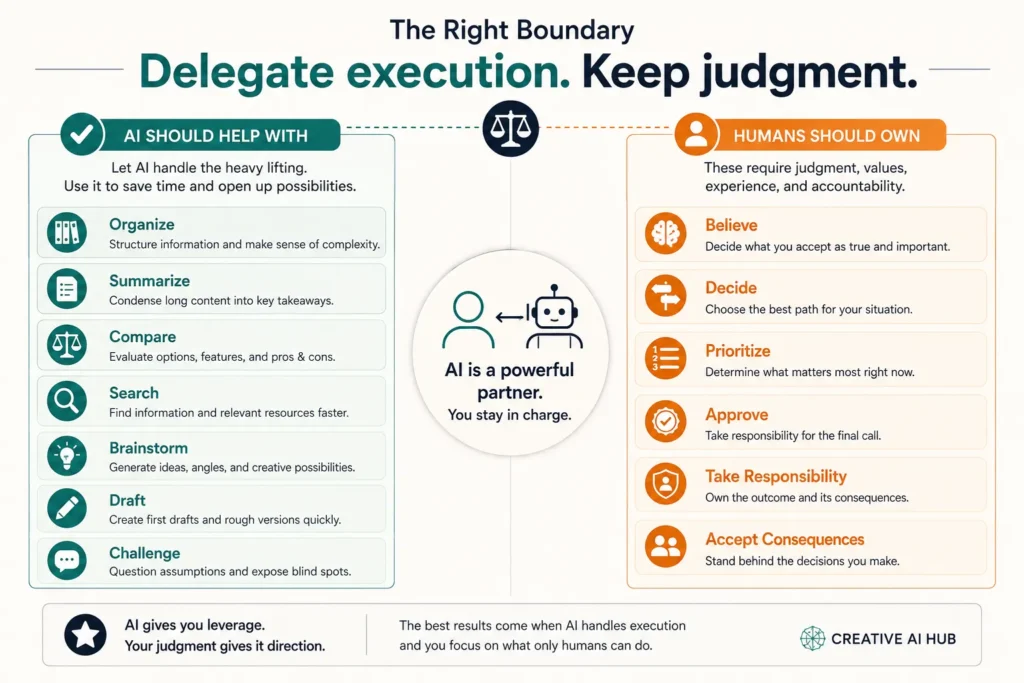
I’ve gradually arrived at one rule that works across almost every kind of AI use:
Delegate execution before you delegate judgment.
Let AI:
- organize,
- summarize,
- compare,
- format,
- search,
- brainstorm,
- challenge,
- draft.
Be much more careful when asking it to:
- choose,
- approve,
- believe,
- prioritize,
- promise,
- interpret consequences on your behalf.
The boundary isn’t perfect.
It will move as AI improves.
But right now, I find it enormously useful.
Because the goal of AI shouldn’t be to remove thinking from work.
It should remove enough unnecessary work that we have more attention left for thinking.
Where I Draw the Line
That principle sounds simple until you actually try to apply it.
Because the line between execution and judgment moves depending on the work.
Summarizing a meeting is relatively straightforward.
Deciding which disagreement in that meeting matters most is not.
Generating ten headlines is easy to delegate.
Deciding which promise your brand should make is different.
Writing code and deciding what should be built are not the same job.
The more I use AI, the less interested I become in asking what it can do.
I’m much more interested in deciding what it should do.
If You’re Writing, Don’t Outsource the Point
Writing is probably the easiest place to see the difference.
Imagine you’re writing an article about remote work.
You could type:
Write a 2,000-word article about the advantages and disadvantages of remote work.
Within seconds, you’d have something perfectly readable.
Probably too readable.
Introduction.
Productivity.
Work-life balance.
Communication.
Isolation.
Conclusion.
Nothing would necessarily be wrong.
The problem is that almost anyone asking the same question could receive something remarkably similar.
Now start differently.
Write down what you’ve actually noticed.
Maybe your team became more productive but junior employees struggled to learn informally.
Maybe meetings decreased but Slack messages exploded.
Maybe people gained two hours by avoiding commuting but somehow felt more tired.
Now give that to AI.
Ask it to organize the contradictions.
Challenge the argument.
Find evidence.
Suggest what you’re missing.
The resulting article has something the first version didn’t.
A reason to exist.
My rule for writing:
Give AI the mess. Keep ownership of the point.
If You’re Studying, Ask for Friction
Education may be where AI’s convenience becomes most complicated.
A student encounters a difficult problem.
They copy it into AI.
An answer appears.
Problem solved.
Except the problem wasn’t really the problem.
The struggle was part of the learning.
Think about learning a foreign language.
If AI translates every sentence immediately, communication becomes easier.
Language learning may not.
The same applies to mathematics, programming, history, and almost every other subject.
So instead of asking:
What’s the answer?
Try:
Don’t give me the answer. Give me one hint.
Then:
Tell me which part of my reasoning is wrong.
Or:
Ask me three questions that would help me solve this myself.
Now AI becomes something closer to a tutor.
A good tutor doesn’t remove difficulty.
A good tutor makes difficulty productive.
My rule for learning:
Use AI to stay stuck for less time—not to avoid being stuck entirely.
If You’re Researching, Make AI Show Its Work
Research requires a different boundary.
AI is excellent at helping you discover:
- terminology you didn’t know,
- competing arguments,
- questions worth investigating,
- possible sources,
- gaps in your understanding.
That’s enormously useful.
But discovery and evidence are different things.
Suppose you’re researching whether a new technology is reducing operating costs in manufacturing.
AI produces:
Companies adopting the technology have reported significant cost reductions.
Sounds reasonable.
But now the important questions begin.
Which companies?
How significant?
Compared with what?
Over what period?
According to whom?
This is where I want AI to become less eloquent and more accountable.
Give me the source.
Show me the date.
Separate the company’s claim from independent evidence.
Tell me when sources disagree.
And if reliable evidence isn’t available, say so.
My rule for research:
Use AI to find the trail. Verify before you trust the destination.
If You’re Coding, Keep the Ability to Debug
Coding creates one of the strangest AI productivity traps.
AI can generate working code remarkably quickly.
That feels wonderful.
Until the code stops working.
If you understand what was generated, AI has saved time.
If you don’t, AI may simply have postponed the difficulty.
Now you’re responsible for software you cannot confidently explain.
For small scripts, that risk may be acceptable.
For production systems, security-sensitive applications, or anything other people depend on, the standard should be much higher.
I like using AI to:
- generate boilerplate,
- explain unfamiliar code,
- suggest test cases,
- identify likely bugs,
- refactor repetitive sections,
- compare implementation approaches.
But there is one question worth asking before accepting generated code:
If this breaks tomorrow, can I understand why?
If the answer is no, the time you saved today may simply become tomorrow’s debt.
My rule for coding:
Automate typing aggressively. Outsource understanding cautiously.
If You’re Making Business Decisions, Ask AI to Disagree With You
This may be my favorite use of AI.
Not asking it what to do.
Asking it why I might be wrong.
Suppose I believe a new product should launch in September.
Instead of:
Is September a good launch date?
I would rather ask:
Assume launching in September is a mistake. Build the strongest case against it.
Then:
Which three assumptions in my plan create the most risk?
Then:
What evidence would make you change that assessment?
Something interesting happens.
AI stops becoming a confirmation machine.
It becomes resistance.
And resistance is incredibly useful when you’ve already spent weeks becoming emotionally attached to an idea.
The final decision remains human.
But the decision has survived an argument first.
My rule for decisions:
Don’t ask AI to agree with you. Ask it to make your reasoning earn its conclusion.
The Workflow I Trust Most
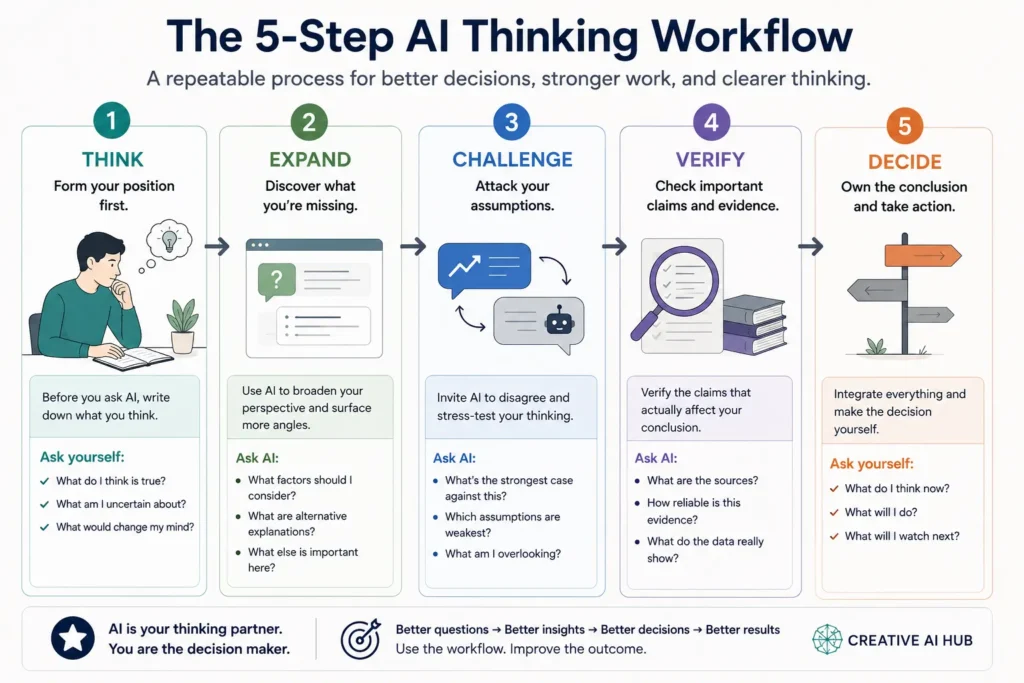
After experimenting with different ways of using AI, I’ve ended up with a five-step pattern.
1. Think
Before opening AI, write down your initial view.
It doesn’t need to be polished.
Three sentences may be enough.
2. Expand
Ask AI what you’re missing.
Alternative explanations.
Risks.
Questions.
Evidence.
3. Challenge
Ask AI to attack your position.
Find weak assumptions.
Construct the strongest opposing argument.
4. Verify
Check the claims that actually affect the conclusion.
Use primary sources when possible.
5. Decide
Close the loop yourself.
Don’t ask:
What does AI think?
Ask:
After seeing everything, what do I think now?
That final step matters more than it seems.
A Simple Test: The Empty Screen Test
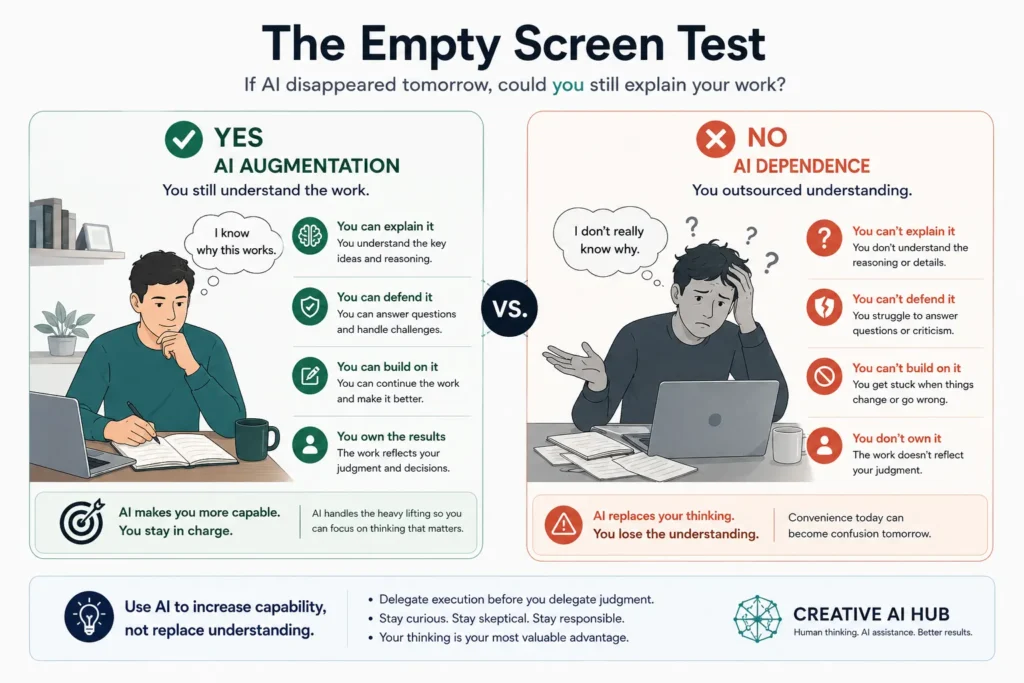
There’s a test I’ve started using mentally.
Imagine the AI disappears tomorrow.
Could you explain why you made the decision?
Could you defend the argument?
Could you explain the code?
Could you summarize the research?
Could you continue the project?
You don’t need to reproduce every sentence AI generated.
That’s not the point.
But you should understand the work well enough to own it.
If removing AI also removes your understanding, something went wrong.
The tool didn’t augment your thinking.
It substituted for it.
The Productivity Number That Doesn’t Show Up on Dashboards
AI companies understandably talk about time saved.
Thirty minutes.
Two hours.
Ten hours per week.
Those numbers matter.
But there’s another metric I’ve become more interested in.
How much meaningful attention did AI give back to me?
Saving twenty minutes only to produce three more mediocre documents isn’t necessarily progress.
Saving twenty minutes and spending it thinking more carefully about one important decision might be.
Productivity isn’t simply doing more things per hour.
Sometimes productivity means having enough mental space to notice that you’re doing the wrong thing.
AI can create that space.
But only if we resist filling every saved minute with more output.
The Warning Sign I Pay Attention To
There’s one moment when I know I’m probably leaning too heavily on AI.
It’s when I accept an answer because it sounds right.
Not because I’ve evaluated it.
Not because I’ve checked the evidence.
Not because I understand the reasoning.
It simply sounds professional enough to move on.
Fluency is incredibly persuasive.
That makes it dangerous.
The better AI becomes at writing confident, polished responses, the more important our own skepticism becomes.
The problem isn’t that AI makes mistakes.
Humans make mistakes too.
The problem is that good writing can make mistakes harder to notice.
A Better Definition of AI Literacy
For a while, AI literacy meant knowing how to write prompts.
I don’t think that’s enough anymore.
The most important AI skill may eventually be knowing when not to ask AI.
Knowing when you need:
- your own first opinion,
- original evidence,
- human experience,
- professional judgment,
- disagreement,
- uncertainty,
- or simply time to think.
The strongest AI users won’t necessarily be the people who automate the most.
They may be the people who understand the boundary between assistance and dependence.
Before You Hand It to AI
Before delegating something important, I ask five questions.
Is this execution or judgment?
Execution is usually easier to delegate.
Will I understand the output well enough to challenge it?
If not, slow down.
Can the answer be verified?
If yes, verify the parts that matter.
What happens if the answer is wrong?
The greater the consequence, the stronger the human review should be.
Am I using AI because it improves the work—or because thinking feels uncomfortable?
That last question isn’t always pleasant.
It’s often the most useful one.
Final Thoughts
There was a period when I measured my AI use by how much I could automate.
More prompts.
More workflows.
More generated content.
More time saved.
I don’t think that’s the right measure anymore.
The question I care about now is different.
After using AI, is my thinking better than it was before?
Sometimes the answer is yes because AI found information I would have missed.
Sometimes it challenged an assumption I hadn’t noticed.
Sometimes it organized a mess of ideas into something I could finally understand.
And sometimes the best use of AI was simply removing an hour of mechanical work so I could spend that hour on a decision that actually required me.
That’s the version of AI productivity I find most interesting.
Not replacing ourselves.
Not proving how much work a machine can perform.
But becoming more deliberate about which parts of work deserve human attention.
AI will continue getting better.
The drafts will improve.
The research will become faster.
The agents will become more capable.
The temptation to hand over one more decision will grow with them.
That’s exactly why the boundary matters.
We don’t need to protect every task from AI.
Quite the opposite.
There is an enormous amount of work machines should probably do for us.
But the purpose of delegating that work should be to protect something more valuable.
Curiosity.
Judgment.
Taste.
Responsibility.
The ability to look at a convincing answer and still ask:
Do I actually believe this?
If AI gives us more time to ask that question, it will have made us more capable.
If it makes us stop asking it, then all that productivity may have cost more than we realized.
Frequently Asked Questions
Does using AI make people worse at thinking?
Not automatically. The effect depends heavily on how it is used. AI can remove productive struggle if it simply supplies answers, but it can also strengthen thinking when used to challenge assumptions, generate counterarguments, explain mistakes, and expose gaps.
What tasks should I delegate to AI first?
Start with repetitive execution: formatting, summarization, first drafts, comparison, organization, transcription, routine research preparation, and brainstorming. Keep stronger human oversight around consequential judgment and irreversible decisions.
Should students use AI?
AI can be a powerful tutor when it provides hints, explanations, practice questions, and feedback. It becomes less useful educationally when it simply removes the reasoning the student was supposed to practice.
Is AI-generated writing bad?
Not inherently. The important question is where the ideas, observations, argument, and judgment originated. AI can significantly improve structure and language without replacing the author’s point of view.
How do I know if I’m relying on AI too much?
Try the empty-screen test: if the AI disappeared, could you still explain, defend, debug, or continue the work? If not, you may have delegated understanding rather than execution.