If you’ve used ChatGPT, asked an AI to create an image, or listened to a song generated by artificial intelligence, you’ve already experienced generative AI.
It might feel like magic at first. You type a few words, click a button, and within seconds, an article, a painting, or even a piece of music appears.
But behind that simple experience is a technology that has been developing for years.
The good news is that you don’t need a computer science degree to understand the basics.
In this guide, we’ll explain how generative AI works in plain English and why it has become one of the fastest-growing technologies in the world.
What Is Generative AI?
Generative AI is a type of artificial intelligence that creates new content instead of simply analyzing existing information.
Traditional software follows instructions that programmers write in advance.
Generative AI works differently.
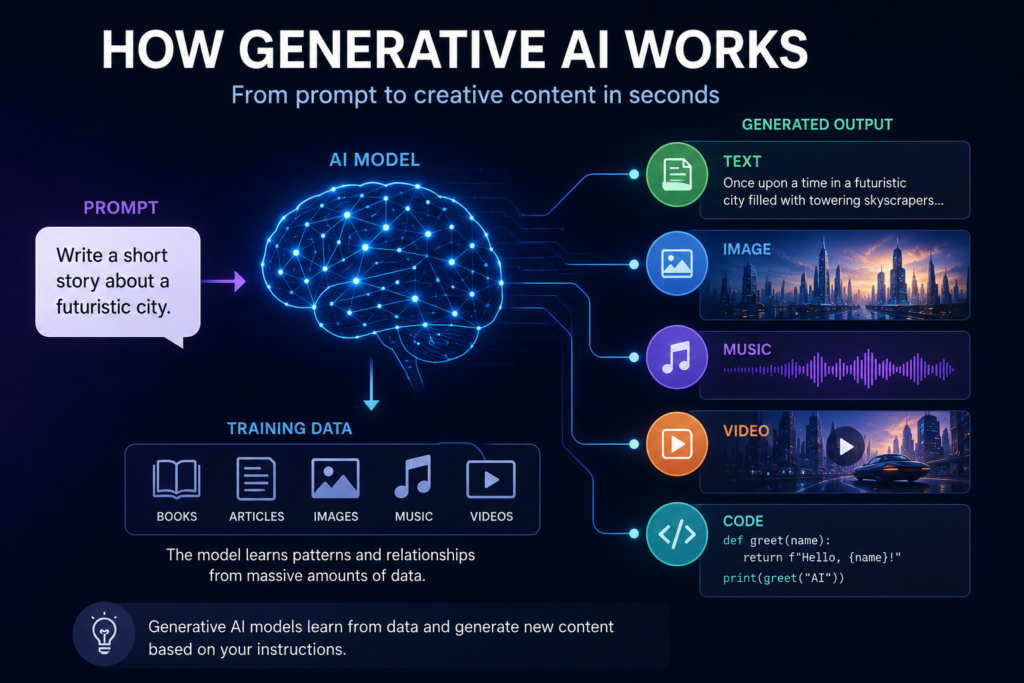
It learns from enormous collections of data and uses those patterns to generate something completely new when you give it a prompt.
Depending on the model, that new content might be:
- Articles
- Images
- Music
- Videos
- Computer code
- Voice recordings
- Presentations
Every result is generated in real time based on your request.
Where Does AI Learn From?
Before an AI model can answer questions or generate content, it has to be trained.
Training involves processing huge amounts of publicly available information and licensed data, depending on how the model was built.
For example:
A writing model studies books, articles, and other text.
An image model analyzes millions of pictures, illustrations, and photographs.
A music model learns patterns from melodies, instruments, and rhythms.
Rather than memorizing everything word for word, the model learns relationships and patterns that help it predict what should come next.
Why Prompts Matter
One of the biggest differences between traditional software and generative AI is the way people interact with it.
Instead of clicking through menus, you simply describe what you want.
This instruction is called a prompt.
For example:
“Write a friendly email to a customer.”
or
“Create a watercolor painting of a lighthouse at sunset.”
The clearer your prompt is, the better the AI can understand your goal.
Learning how to write effective prompts is becoming an increasingly valuable skill.
Does AI Think Like Humans?
This is one of the most common misconceptions.
Although AI often produces responses that sound natural, it doesn’t think or understand information the way people do.
It doesn’t have emotions, beliefs, memories, or personal experiences.
Instead, it predicts the most likely sequence of words, pixels, notes, or code based on patterns learned during training.
That’s why AI can sometimes make mistakes or confidently provide inaccurate information.
What Makes Generative AI So Useful?
Generative AI has become popular because it saves time on tasks that used to take much longer.
Today, people use it to:
- Draft blog posts
- Create marketing content
- Generate illustrations
- Produce background music
- Edit videos
- Write computer code
- Summarize long documents
- Brainstorm new ideas
For many users, AI acts like a creative assistant that speeds up the first draft, leaving people free to focus on reviewing and improving the final result.
Can AI Replace Human Creativity?
Probably not.
AI is excellent at generating ideas quickly, but it still depends on human direction.
The best results usually come from people who know exactly what they want and use AI as a tool rather than relying on it completely.
A designer can create better artwork with AI.
A writer can overcome writer’s block.
A programmer can solve problems more efficiently.
In each case, human judgment remains essential.
Why Understanding Generative AI Matters
Generative AI is no longer limited to technology companies.
It’s becoming part of education, business, healthcare, entertainment, marketing, and everyday work.
Even if you don’t plan to work in the tech industry, understanding how these tools function can help you use them more effectively and recognize their limitations.
The better you understand the technology, the easier it becomes to choose the right AI tool for the right task.
Final Thoughts
Generative AI may seem complicated, but the basic idea is surprisingly simple.
It learns patterns from vast amounts of data and uses those patterns to generate new content based on your instructions.
That’s why the quality of your prompt often matters just as much as the AI tool itself.
As AI continues to evolve, learning how it works will become a valuable skill in almost every profession.
In the next article, we’ll look at some of the best free AI tools available today and help you decide which ones are actually worth trying.
Next Reading: The Best Free AI Tools You Can Start Using Today (2026)