Artificial intelligence has become part of everyday life, even for people who don’t think of themselves as “tech people.” Whether you’re asking a chatbot to help write an email, using your phone to organize photos, or watching a streaming service recommend your next movie, AI is already working behind the scenes.
Despite how common it has become, many people still wonder what artificial intelligence actually is. Is it a robot? Is it something that replaces human jobs? Or is it simply another software tool?
The answer is somewhere in between.
This guide explains what AI is, how it works in simple terms, and why understanding it has become useful for almost everyone.
What Is Artificial Intelligence?
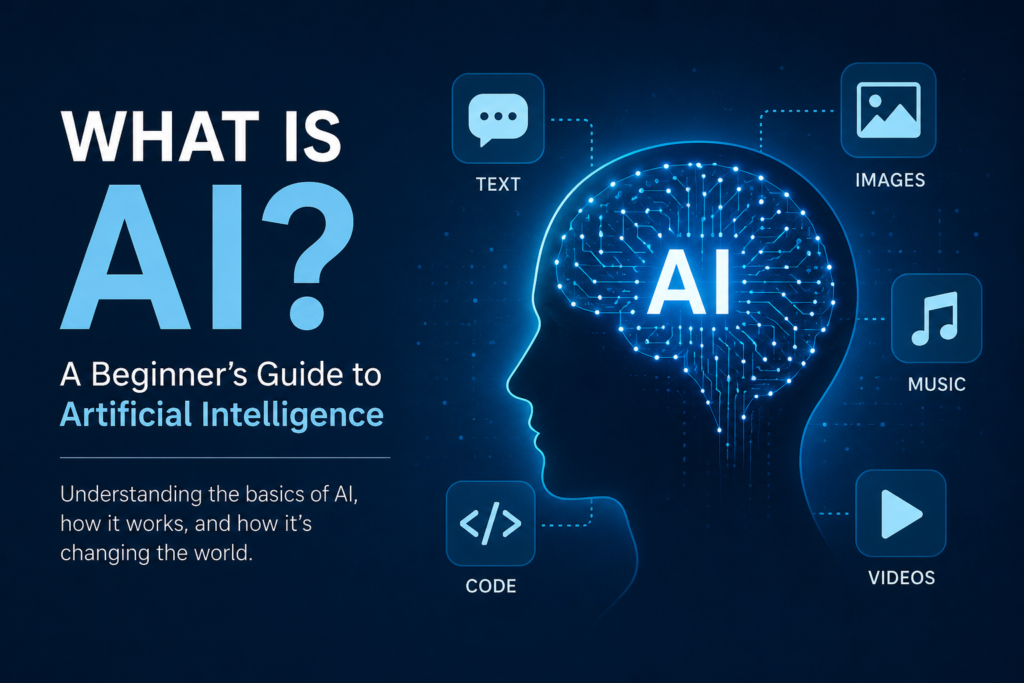
Artificial intelligence, often shortened to AI, refers to computer systems designed to perform tasks that normally require human intelligence.
Instead of simply following a fixed set of instructions, AI systems can analyze information, recognize patterns, learn from large amounts of data, and generate responses based on what they have learned.
Different AI systems are built for different purposes. Some recognize speech, others generate images, while some help write documents or analyze business data.
Although AI often seems incredibly intelligent, it doesn’t “think” the way humans do. It predicts and generates results based on patterns found in enormous datasets rather than understanding the world through personal experience.
AI Is Already Part of Everyday Life
Many people use AI every day without realizing it.
Here are a few familiar examples:
- Email services filtering spam automatically
- Navigation apps suggesting faster routes
- Smartphones recognizing faces to unlock devices
- Translation tools converting languages in seconds
- Shopping websites recommending products
- Streaming platforms suggesting movies and TV shows
- AI assistants helping write emails or summarize documents
These examples show that AI isn’t just a futuristic technology. It’s already woven into everyday routines.
What Is Generative AI?
One of the biggest developments in recent years is generative AI.
Unlike traditional software that follows predefined rules, generative AI creates new content based on user requests.
Depending on the tool, it can generate:
- Articles and blog posts
- Images and illustrations
- Music
- Videos
- Computer code
- Presentations
- Voice recordings
This has made AI accessible to students, business owners, marketers, designers, programmers, and everyday users alike.
How Does AI Learn?
Most modern AI systems are trained using enormous collections of data.
During training, the AI analyzes millions—or sometimes billions—of examples to recognize relationships and patterns.
For example:
- An image model studies countless photographs to recognize objects, colors, and styles.
- A language model learns from books, websites, and other written material to predict the next word in a sentence.
- A music model analyzes melodies, rhythms, and instruments to generate original compositions.
After training, the AI uses these learned patterns to respond when users ask questions or provide instructions.
What AI Can Do Well
AI continues to improve quickly, and it already performs many tasks remarkably well.
Some of its strengths include:
- Summarizing long documents
- Brainstorming ideas
- Translating between languages
- Creating first drafts
- Analyzing data
- Generating images
- Assisting with programming
- Organizing information
For many people, AI works best as an assistant rather than a replacement for human expertise.
What AI Still Can’t Do
Despite impressive progress, AI has important limitations.
It can occasionally provide incorrect information, misunderstand context, or produce overly confident answers that are simply wrong.
AI also lacks human judgment, emotions, personal experience, and common sense in many situations.
Because of this, important decisions involving health, finance, legal matters, or safety should always be reviewed carefully instead of relying entirely on AI.
Using AI effectively means understanding both its strengths and its weaknesses.
Why AI Matters More Than Ever
Artificial intelligence is changing the way people learn, work, and create.
Businesses are adopting AI to improve efficiency.
Students use it for research and studying.
Writers use it to organize ideas.
Designers generate concepts more quickly.
Developers write code with AI assistance.
Even small business owners can now access tools that were once available only to large companies.
Learning the basics today can make it much easier to understand future technologies as AI continues to evolve.
Final Thoughts
Artificial intelligence is no longer a niche technology reserved for engineers or researchers. It has become a practical tool that millions of people use every day, often without realizing it.
Understanding what AI is doesn’t require a technical background. Once you learn the basic concepts, it becomes much easier to explore the growing world of AI tools and decide which ones are genuinely useful.
In the next article, we’ll take a closer look at how generative AI works and why tools like modern AI assistants are able to create text, images, music, and even computer code from a simple prompt.
Coming Next: How Generative AI Works: The Technology Behind ChatGPT and More